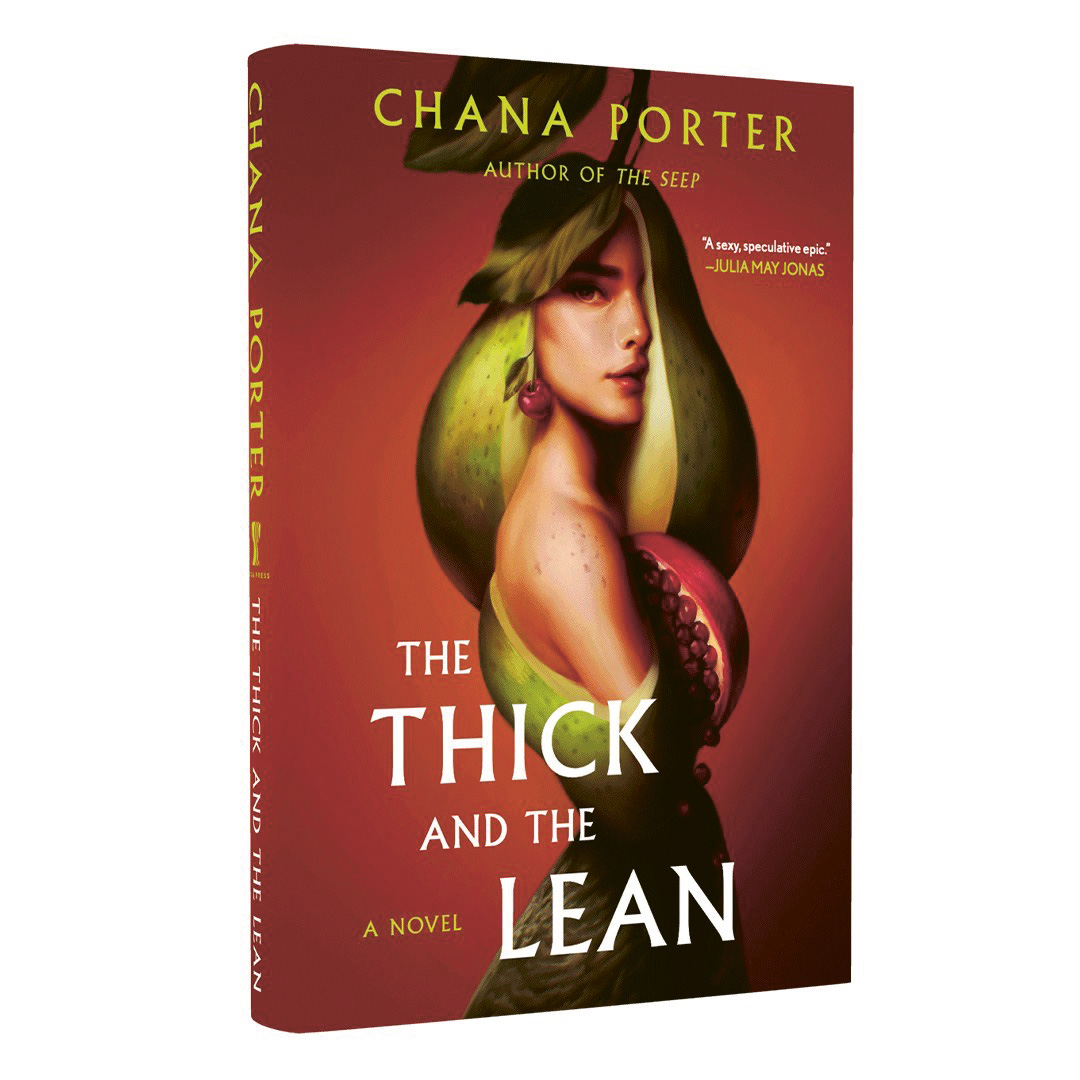
The work of the American playwright and sci-fi novelist Chana Porter is deeply sensual. In her first novel The Seep (2020), alien beings come to Earth in the form of a viscous substance that can enable psychic bonds between all living matter. The seemingly benign alien invasion wants to learn from humankind, and gives in return the gift of possible immortality, material abundance and utter fluidity in the shape people can choose for themselves, be it in the form of an animal or a weird hybrid, or taking the face of a long-dead lover.

Being reborn as a baby and starting life anew is the choice of the wife of protagonist Trina, a fifty-year-old trans woman. In her second novel The Thick and the Lean (2023), Porter depicts a world where the predominant religion prescribes abstaining from food as the way to God. In this world, sex is omnipresent, and (liquid) food is mainly consumed in secrecy and privately, surrounded by guilt. She describes a fantastical world where people try to ascend by starvation and reach for the sky through architecture and fashion. Nevertheless, in this extremely stratified world, greed, capitalism and colonialism are as destructive as in our own world. I met Chana during a residency for women sci-fi writers in Mexico City and Oaxaca in the summer of 2023. She found the best places to eat, kept up the morale of the group with her cheerfulness and read our Tarot cards with uncanny foresight.
Fiep van Bodegom: Starting with writing, because that is how we met, talking about writing: do you think there is something erotic in writing?
Chana Porter: Yes! Writing helps me realise what I think is my prime love affair – between me and the world. I think writing is the best way that I have to articulate and express that very real passion and desire that I have for what you could call God, or the divine, or just everything altogether. When I physically write, when I’m generating something new, it feels visceral, and sometimes sexual. In both The Seep and The Thick and the Lean there is a feeling of permeating eroticism, that sex could happen at any time as people move through the city. I think that’s partially just my own fantasy. What sort of world would make me feel safe enough that if I had an impulse or desire, I could follow that anywhere? I know we can create containers for that in our current reality, but I depict a city like that in both my novels – I’m thinking about Beatrice with the man in the park, and Trina when she picks up the woman at that restaurant. Sex is something that could just erupt. There’s something so natural about that, yet I have never lived in such a way; and I think probably most people have not.
…If in our reality you’re someone who goes to a sex club, part of what you’re going to is this space to experience a taboo…
Fiep: You say there is something natural about describing it this way, but you have not experienced it. Where does this sense of naturalness come from?
Chana: Sometimes when I’m walking and the sun shines in a certain way, or the air is a certain temperature or it’s the first nice day after a long, cold period, I feel like the world is having sex with me (laughter). This opens the larger question: what is sex? And I do know for myself – desire is a landscape I travel through, when a beautiful stranger appears in one of those times in which I already feel like I was in some kind of thrall, in some sort of romantic process between me and world, I would not feel safe enough to do anything sexual with that person. That is where my impulse stops.
One time, when I was a teenager, a boy came up to me on a bus and kissed me. And it was really great, it was one of the great kisses that I’ve had. And I knew I had crossed a line, that it was not something any nice self-respecting girl would do, but I’d already crossed it, liked it, and I had to back-pedal.
I think I do have a part in this relationship to a greater worldly sensuality, because I write novels where there is more porousness in terms of when and how erotics can happen. If in our reality you’re someone who goes to a sex club, part of what you’re going to is this space to experience a taboo. I feel like some of the people at the sex club wouldn’t be there if it was a non-taboo, non-charged environment.
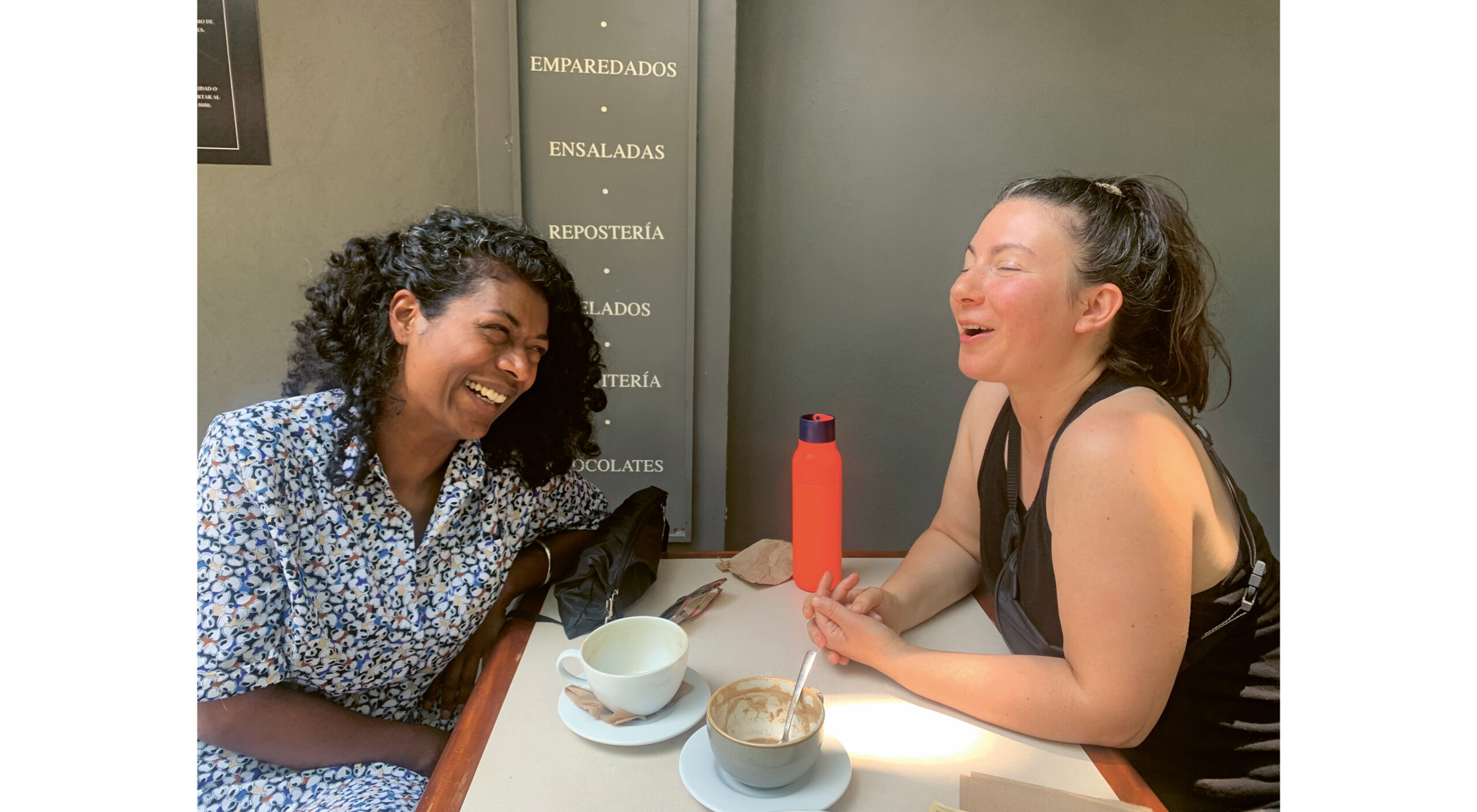
Courtesy of Fiep van Bodegom
Fiep: So, for visitors of a sex club, part of the excitement is the taboo. Would you consider the erotic as any joyful interaction with the world? As something that is actually quite far from something like a sex club?
Chana: Not any joyful interaction. I’m staring at this magnolia tree out of the window, in Brooklyn, right now. And there’s all these leaves. At some point it will flower. The tree is in its own process, just the way that I’m in my own process; and sometimes the space between me and the tree feels more permeable. I’m very interested in that sensual, erotic feeling of being part of the natural world. Sex serves all kinds of natural purposes, but it’s also this deep drive.
Fiep: I read The Seep as, among other things, an argument with yourself about what desire is among abundance. What if you love something very specific and exclusive to one person? Do you think abundance deadens some forms of desire?|
Chana: It certainly can. A perfect example of that would be money. If you have an abundance of money, it becomes a hungry ghost, an insatiable ghost, because that is the way the brain is wired in the sense of dopamine. We think that there are all these outside stimuli, be it goals to attain, things to buy or different kinds of pleasures. I think that the capacity for pleasure comes from emptiness. That is not to say scarcity is better than abundance, but knowing when to stop, when to do nothing, when to be bored, these are all very important tools to have. I don’t think that love or pleasure is finite, but time and attention have limits. The Seep asks: What do we really care about if there is no pain? Or when pain is just a game you can choose to play? However, I think hard things are valid and worthy. That’s not to say I want to put suffering or scarcity on a pedestal. I want there to be plenty of everything for everyone, especially tenderness.
Fiep: You play a substitute game in The Thick and the Lean between food and sex. The conclusions are quite complex, because they’re not opposites to begin with. What did you find out about the eroticism of food and sex when you swapped their positions in the society you describe?
Chana: When I thought about flipping the food/sex taboo, I thought it would be a pithy short story. I wanted to unpack some of my history with both dieting and purity culture, especially as a teenager, when my body was changing and I was presented to the world as a sexually available woman. I felt a tangle of expectations – to be sexy but not sexual, never to diet but not to get fat. I felt that my body, just from outside expectations, was being pruned like a tree. It had a lot to do with appetites, and I didn’t know or understand, as a queer person too, what I was attracted to. I focused so much on myself as an object, something other people desired. Pleasure came from another person desiring you rather than connection to your own impulses. So that was the start of the book, and, as I dug, I realised it had to be very long, because it’s a tangle. Part of it is that I thought (laughter) I had made up this religious dieting cult, but there are already many! I watched a lot of documentaries about them. Scientology has a whole food and exercise angle that is hard to find about, because it is quite secretive. I watched The Way Down (2021–22), an HBO documentary series about a born-again church in the South of the United States, where this woman was having people pray their fat away. I couldn’t watch too much because it becomes a really sad story about child abuse. The control of the body is knitted into their ideology of controlling children, all packaged under this idea of ‘we need to be utterly in control of our bodies to be receptive to God.’ It has been a little scary to me, because I thought I was making this stuff up but they are things that are already in many pockets of our culture. These groups are a bit fringe, but I don’t think it is a stretch to say that absolute control over your body and the idealisation of thinness, especially for women, is completely woven into greater societal expectations of what it means to be a ‘successful’ woman; we should take up space in a particular way, and, no matter what we think, do or accomplish, always be an object of desire. I like the mess of how the swap doesn’t feel neat, I wanted it to be complicated.
…we should take up space in a particular way, and, no matter what we think, do or accomplish, always be an object of desire…
Fiep: You have great fun making things up in this new world, such as formulaic, boring television shows with a great deal of graphic sex. People are getting tired of it, it’s the banal background of their lives. At the same time, there are underground restaurants where people eat together in secret. Were you surprised at how this swap uncovers how desires and taboos around sex and food are related?
Chana: It was difficult to a certain extent, because I’m a very food-motivated person (laughter). It was wild for me to think about. How would people spend money in a world without a restaurant culture? Luckily, I moved to Los Angeles a few years ago and discovered people find plenty of things to spend money on. It is fun for me to think, OK, there is going to be a huge cleanse and juice culture in the book. I didn’t want to adopt a straightforward way everyone approaches the religious text. I wanted there to be some people who only do liquids, and some people who chew very bland food, but like at home, behind privacy screens. I wanted some people to live on mostly supplements, and people who really stretch what the scriptures said about what is solid and they eat these – what I can only imagine to be pretty gross – aspic creations. It was fun for me to think about the architecture, because in churches the doctrines are being interpreted. There is a penchant in the architecture for things that float and hairstyles that make you look taller, according to the idea that being higher or further from the ground is holier. I imagined people with very pointed hair and towering platform shoes. Also parks with bridges, but the bridges are over nothing, they’re just over dirt; and because it is sci-fi, you really have houses that are floating, which is fun.
Fiep: There is a lot of shape-shifting – intentional and unintentional – in your books.
Chana: I love this idea of shape-shifting. All my plays have something of it, a person changing into an object, or a dead person in the body of the living.
Fiep: Maybe my question is how to love something for what it is and the way it inevitably changes. How to do both?
Chana: I think, as a US citizen, when you critique your country, you are told it is because you don’t love it. For me, it’s a great act of love to try to make something better, or at least see it for what it is. However, you know, countries aren’t people – they’re just a collection of ideas that we carry – to love something is definitely to let it change but also to let it be. What we are taught in the greater culture, particularly about romantic love, is not necessarily love. Rather, it is a feeling that we associate with receiving praise or feeling safe, being around someone who makes you feel good about yourself. Yet if we are all mirrors to each other, and mirrors of the greater reality, to love is maybe to really look, to really see what is. Personally, I feel that has much less to do with other people and more with yourself.
Fiep: In the last story in The Seep, there is this boy Aki, through whose eyes we see a new world. He escapes from the compound, a place that has been separated from the Seep, the alien power that thinks it knows humankind and will be able to take away all sorrow. Aki, on the other hand, is looking for someone unkind. And it seems he’s definitely on an erotic quest. So how do you relate those two things?
Chana: Yes, he definitely is! The Seep is an exploration of what you could turn negative feelings into: sadness, grief, loss, frustration, not wanting to move on, not wanting things to get better, not wanting to improve. Sometimes I feel that I am on a constant wheel of self-improvement, which seems to be consumerist in nature. I’m supposed to be this perfected version of myself, and I can get there by reading a book, becoming a better meditator, eating certain foods or trying to optimise my brain chemistry, but I wonder about the quest behind them. It seems to me that both Trina and Aki, in their own different ways, are trying to experience a more nuanced and wholly alive reality that is not just flattened into softness, kindness and positivity.
Fiep: You’re very good at the depiction of the good life. You describe the perfect dinner party – The Seep opens with ‘Tips for throwing a Dinner Party at the End of the World’ – or the perfect outfit. Yet not as a criticism of consumerism. What do you think about these scenes, also in literature more generally, of the depiction of the good life as something truly joyful?
Chana: I don’t think it’s a contradiction. In that Seep dinner party, sharing soup and bread with friends is the best (laughter). I think it’s important to show Claudia in the ‘Above’ section of society with her long skin-care routine and her relationship with the food she has access to. From a literary motivating point of view, it is important that I show the things Claudia wants, why she stays in that world. I think it is very telling that Claudia is the only character we eventually see on a binge when she orders all that food into her bathroom and consumes it there, as if she is covering up a crime scene.
Fiep: You were saying that some of the relations between dieting and religious control you thought you created for The Thick and the Lean already existed in the real world. Was this new diabetes medicine, Ozempic, already on the market when you wrote it? Because the ‘yellow pill’ in that novel is something like that, isn’t it? A pill that ‘frees’ you from the desire for food.
Chana: I know! It really freaked me out, because it was the most horrible thing that I could imagine. I would not describe myself as a thin person, but I don’t know how it would feel to be in a much larger body. If your doctor says you have to take it, maybe you have to take it. When I was writing, the idea seemed to be such a bitter trade, of giving up desire, actual hunger, appetite and pleasure. Since the book came out I have read accounts of users of Ozempic. Some people praise it, because they had the feeling they had noise in their head around food, at all times, and that stopped. For me, that noise, which is very connected to your observations about the good life, food pleasure, is an immense part of life. Sometimes, it is going to be an amazing mole [a traditional Mexican sauce] place in Oaxaca, but most of the time it means me cooking, predominantly vegetables, in my home, knowing that they will nourish me and the people I love. Such nourishment is bound to pleasure. As if I am checking in with my body: what are you hungry for? And that is a kind of clue to what you might need. When I came up with the ‘yellow pill’ I thought that it was something so sad, and something that would never happen. I thought people would never voluntarily take something that makes food taste bad to them, so that they can just eat a little to not feel light-headed, and then go about their day.
Fiep: In both novels there’s a constant tension between necessity and pleasure. I’m still curious – you’re thinking about utopia, but your protagonists are not satisfied. Seagate is egalitarian, the Seep does away with death, and yet your protagonists are very unhappy in these worlds.
Chana: I think the people in Seagate are only happy because they’re drugged, you know (laughter). It’s neither here nor there, but I don’t think that happiness is the top of the mountain. That’s not what we should be reaching for as part of the thing to solve, as part of the human condition. Part of the joy, pleasure and sensuality of being alive is the whole palette. Also, part of our world is so busy and so stimulating, particularly with technology now, that it can be hard to be quiet and still enough to notice that all of these seasons or weather are within your own body at all times. We walk around feeling; she made me mad, or he made me happy, or that made me angry or sad. But I think that most of the time we actually project on the outside stimuli. Those emotional fluctuations would be happening within us, no matter what, because that’s what being alive feels like. This is not to say that you cannot look for a greater sense of contentment, what I like to think about in terms of safety, is whether your nervous system feels safe.
I think Trina is leaning into pain as a way to lean into love. It’s a book about grief, and grief as proof of love, of life, of the fact that what you went through mattered.
Fiep: You started as a playwright and you’re working on the film adaptation of your novel The Seep. When we write it’s just a file on our computer, and even when it’s read it’s done in silence and solitude. Is there something erotic in other people performing your text?
Chana: Oh, my god, yeah. It’s hot (much laughter)!
Fiep: (Laughter) I thought you would say that.
Chana: There is nothing like having your play put on. I would love to do it more. It’s not just the people saying their parts or moving their bodies in space – it’s all magical. There is a set design, a sound design, and the lights get used and there are so many people involved. Everyone gathers together, and the way that people perform the play is completely changed by the presence of an audience. You sit there, in the dark, mesmerised. I have to say there is also something very sexy to me, in a hidden, sweet, demure way, hearing from people ‘I just read your book’ or ‘I’m almost done’ or ‘I passed it on to somebody.’
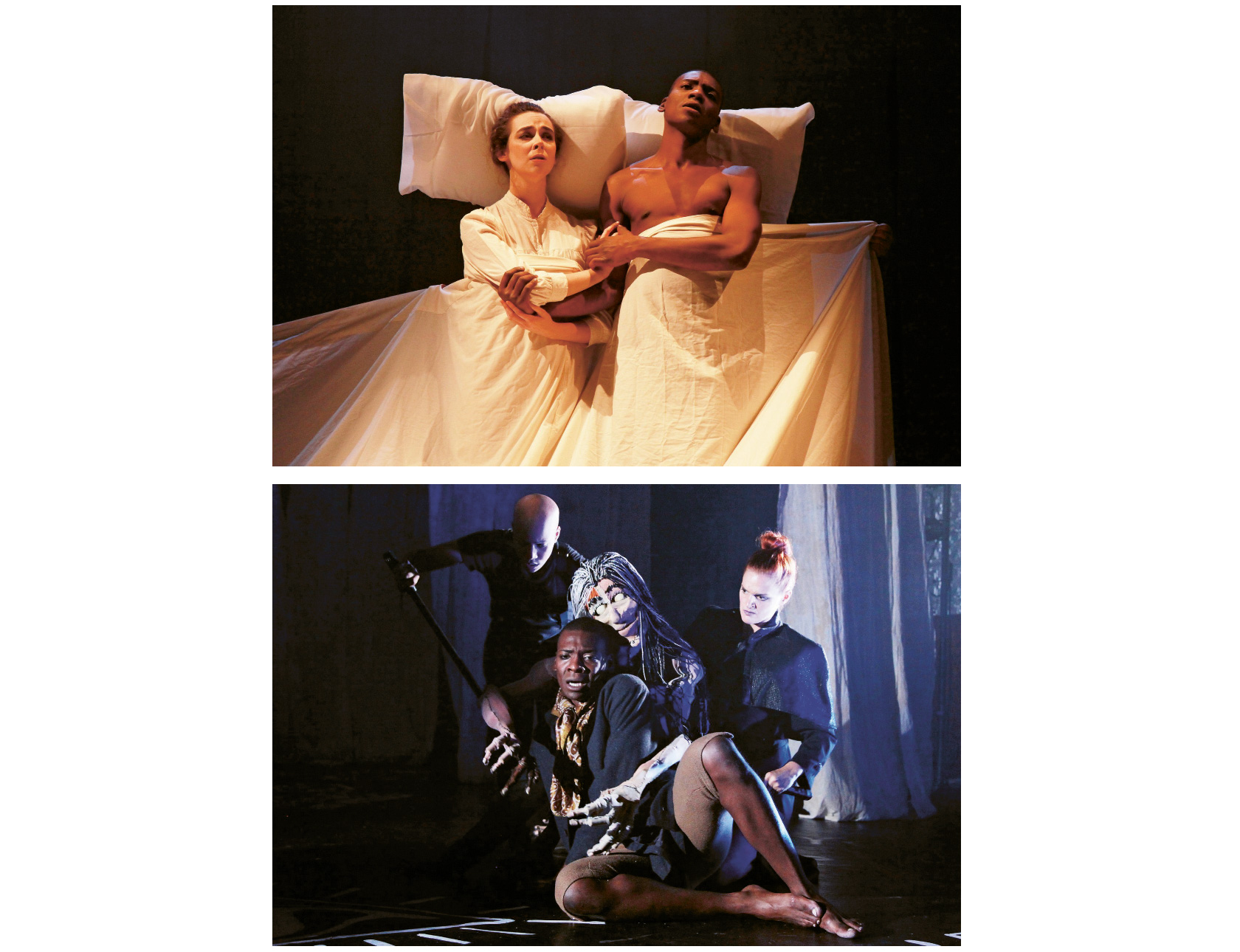
Chana Porter is a playwright as well as a novelist. Intertwining fiction with reality, her play Phantasmagoria;
or, Let Us Seek Death! (2016) tells the story of Frankenstein and its author Mary Shelley in a completely new way. Bringing in historical figures such as the romantic poet Lord Byron, the play examines the significance of living life unapologetically, exploring issues of gender and sexuality. Courtesy of Theo Cote
Fiep: I’m curious about your influences.
Chana: The Seep is very much influenced by Samuel Delany’s Trouble on Triton (1976), but also by Rachel Pollack, particularly Temporary Agency (1994).
Fiep: Do you feel, as a writer, that you can take from other writers what you want?
Chana: I warn students that if you watch a lot of sitcoms or YouTube make-up tutorials, these things will come out through the text, one way or another.
I read and watch a lot, and see a lot of art, but I’m more ethically concerned about taking stories from peoples’ lives that have been told to me. Something about me and my face, maybe my chubby cheeks, I don’t know, people tell me their heavy stuff, even when I don’t know them. Since I’m always filtering it through the lens of a new novel or play, it’s very hard for me not to have that in one way or another digested into the manuscript. Luckily, most of the time it’s digested enough that if the person read it, they wouldn’t even know. I’m just getting something about the way the story has been told. But I’m very careful about it – if it is a writer or someone with a very different identity from mine, most of the time I’m not going to touch it. Whether you do or don’t do anything with it, our stories are something like writer fuel in the way that both novels you’ve read of mine are deeply personal. They have all kinds of things that have happened to me filtered through all those prisms, so that they are no longer recognisable, but the emotional stuff is still present. If I write something, and not much is changed from what someone told me, I’ll get them to approve it, and if they don’t, I take it out.
My writing practice is very much about ethics. I don’t believe in literary theft the same way. I think plagiarising is a real thing, but if you read a novel that has a certain power dynamic and you explore a certain similar power dynamic in subsequent work, I don’t think you’re stealing, I think you’re building, in the sense most art is building off from many, many things.
Fiep: I find it interesting that you tell your students that everything they read ends up in their work. There is no choice of influence, you’re so porous that everything you consume will also come out in your work, one way or another.
Chana: There was a time when I was pretty depressed and I watched a bunch of sitcoms for months. I thought they were so dumb; I just needed to turn off my brain. Afterwards, I ended up writing a very intense play, where at one point during a violent part the fourth wall breaks, and the characters get sucked up into a sitcom because they can’t handle what’s happening. In sitcoms, everyone lives these little archetypes, conflicts are light, the stakes are low and everything is solved in 21 minutes. In Doubles, the novel I’m working on right now, there is a YouTuber. Watching YouTube has been a form of sitcom replacement for me. It’s very telling to me now that this novel has a huge storyline of people making their own talk shows from their cell phones. I don’t think there is ever a time when you turn your mind off.
In formal aspects, my climatic scene of The Seep is pretty similar to some of the climactic scenes in Rachel Pollack’s Temporary Agency. She was also my mentor in my graduate programme – she read that book many times.
…Part of it, which I have never articulated until talking with you, is that a huge part of my writing process is this ongoing love affair with the world…
Fiep: I feel, as a teacher, I’m just imitating the teachers I’ve had. How does it feel for you to teach writing students?
Chana: It feels strange. It’s such a presentation of self. Part of it, which I have never articulated until talking with you, is that a huge part of my writing process is this ongoing love affair with the world. I’m not talking about that when I talk to people about my or their writing process. Maybe I should start. Maybe I should say: when you fall in love with the world, you’ll probably write better books.