Which contemporary director’s body of work best represents the experience of living through the past five years? My answer would be the Romanian director Radu Jude. Jude’s films scroll with rapid-fire thumb-swipes across AI slop, TikTok livestreams and leaked sex videos, all the while offering politically acute and historically rooted observations on the absurdity of contemporary life. If the current times were an arm, Jude is taking its pulse, opening up the vein to see the colour of its blood, while simultaneously reading its palm at 200 words per minute.
In the brilliantly titled Do Not Expect Too Much from the End of the World (2023), overworked production assistant Angela is hectically driving around Bucharest while she squeezes in livestreams masked with an Andrew Tate lookalike TikTok filter spewing macho verbiage for a shot of catharsis. An avid collector of quotes, memes and anecdotes, Jude picks out a wide array of materials from his deep pocket and displays them in thoughtful juxtapositions: the photo-essay The Dead Nation (2017) combines photographer Costica Acsinte’s 1937 and 1944 black-and-white photographs with diary excerpts from a Jewish doctor of the same period to outline the rise of anti-Semitism in Romania; Eight Postcards to Utopia (2024) show-cases Romania’s post-socialist embrace of consumerism in an unrelentingly quickfire montage of TV ads; and Sleep #2 (2024) is a compilation film entirely comprised of livestream web-cam recordings of humorous happenings that take place in front of Andy Warhol’s grave in Pittsburgh, collected from over a year’s worth of obsessive viewing.
This year has not seen him slow down. Shot in ten days on an iPhone, Kontinental ’25 (2025) explores the lack of empathy surrounding the housing crisis. When an eviction she oversees leads to a suicide, the Cluj-based bailiff Orsolya is struck by guilt in this dramatic comedy that swings from ludicrous to heartfelt and back again. AI and Dracula might seem like strange bedfellows at first, but they’re both bloodsuckers who leech off the lives of others in Jude’s latest film, Dracula (2025). Intentionally all over the place in a way that imitates the hallucinatory behaviours of AI, the zany, outrageous film sees him bringing the much-mythologised figure from endless Hollywood regurgitations back to its Romanian origins.
Ever versatile and prolific, the one-of-a-kind director found the time to pause and reflect on his career thus far before he sped off to his world premiere of Dracula at Locarno Film Festival.
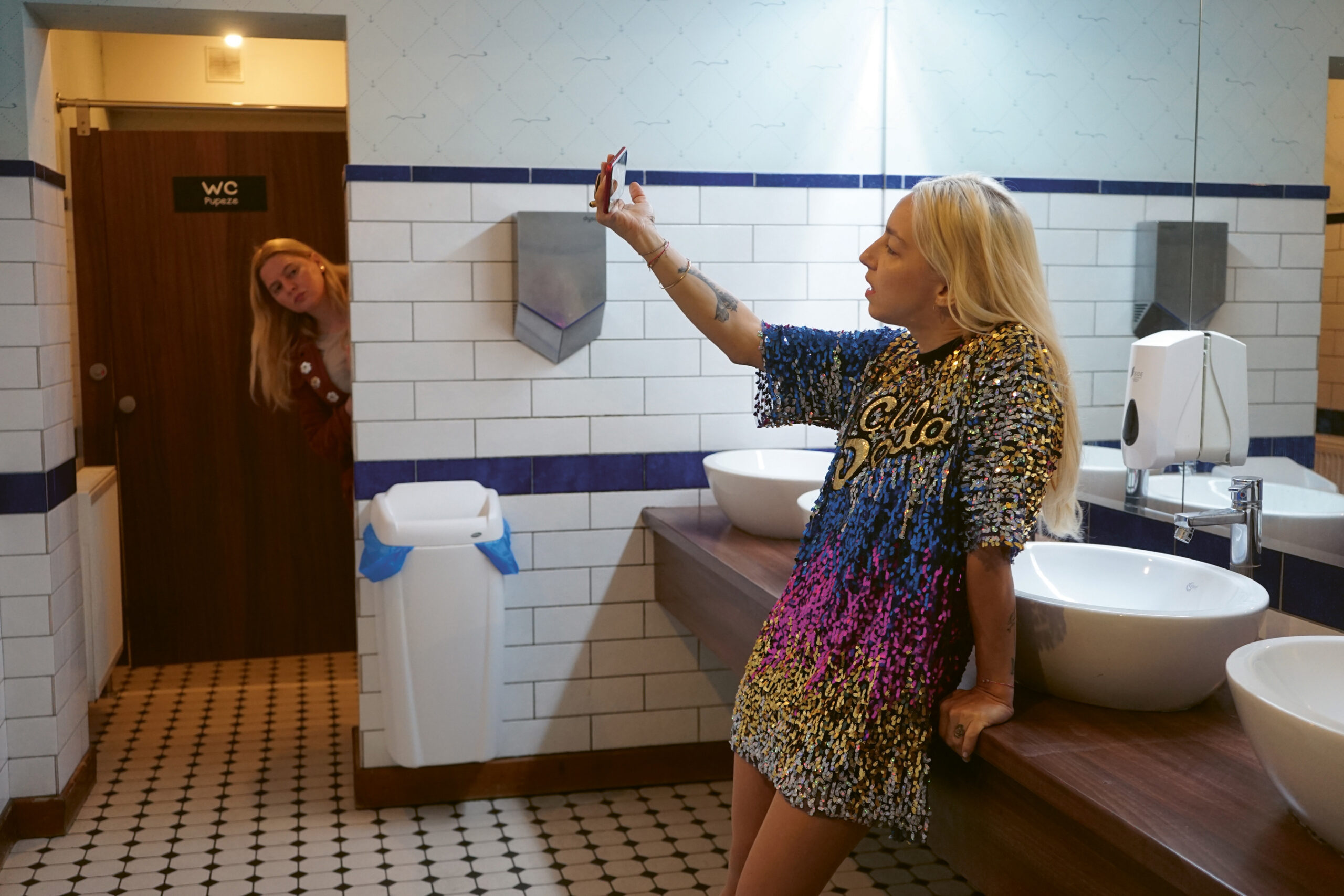
Do Not Expect Too Much from the End of the World, 2023. Courtesy of Radu Jude
Julian Ross: Many filmmakers shy away from the present moment in an attempt to make their work timeless. You, on the contrary, seem to dare to tackle the present. From the AI-generated imagery in your most recent film Dracula to the COVID-19 masks in Bad Luck Banging or Loony Porn (2021), your films are like timestamps. Is filmmaking a way for you to digest the present moment?
Radu Jude: I just saw Bad Luck Banging or Loony Porn again because we are making 35mm copies for archival purposes. I watched the whole film for the first time in a while, and I was shocked at how strange it felt already. It’s only been five years since we made it in September 2020, but everything feels so distant – all these people with masks on and all the conversations on medical dictatorship and sanitary measures. It felt a lot stranger than when we shot the film; back then, we were in the same soup, so to speak.
If I think back to my own development, my sensibility was shaped by making a number of films – short films and found-footage documentaries – that dealt with history. In these, I worked with historians and became, let’s say, an amateur historian – although, as Godard said, any filmmaker is also a historian. Bad Luck Banging and Loony Porn was the first film I made about contemporary times after a string of historical films, and I realised that my gaze and sensibility had changed and were newly informed by a historical perspective. What I mean by that is I trained myself a little to see the connections between everything. I wasn’t only looking at whatever is of high importance politically, like a peace treaty or a bombing, but also at the small things – and began to see the bigger historical events within them. With this perspective, I began to see the historical dimension of whatever I was looking at in the present moment.
One of the pleasures of making films set in contemporary times is in grasping elements that will likely become historical relics within a year or two, and which would normally be discarded by bigger history. It’s the same pleasure one has at an archaeological museum. People look at very trivial things, like a shoe or a pencil from the past, but they would never pay the same amount of attention to objects around them in their everyday life. We don’t apply the same intensity of gaze. That’s what I try to do: direct this intensity of gaze towards the contemporary, like it’s already history.
Julian: When addressing ‘small’ moments in history, it often becomes more personal, as it usually involves individuals rather than political figures or groups. You could say the same goes for small moments in the present, at least, compared with current events in newspaper headlines. I read that Kontinental ’25 is based on a news story that you came across about a bailiff struck by guilt when a person whom she evicted committed suicide – a kind of story that would be forgotten by most people years later. Unlike historical events, presumably such a story is still raw for those involved. Can you reflect on how to navigate ethics in representing such contemporary stories?
Radu:Well, yes, it’s an issue and an impossible problem to solve. We live in horrible times – look at Gaza and Ukraine. We are getting so used to seeing footage that we forget the actual horror of it. What is happening in Gaza is devastating, and I hope we don’t forget Ukraine, whose civilians are being sent to war to defend their country. I have the feeling that the people in the West somehow got used to this war. We say ‘army’ like it’s something abstract, but in the end it’s just people like you and me, who are taken from the streets and sent to die. I feel a sense of uselessness unlike anything I have felt before.
I Do Not Care If We Go Down in History as Barbarians (2018), for example, might seem to be about historical representation and a mas-sacre, but actually the film beneath the first layer is about the uselessness and the incapacity of doing anything for the present. I think it’s important to acknowledge this feeling of futility. It’s a very pessimistic film. Nowadays, I see a lot of people posting ‘ceasefire now’ and things like that on Instagram in ways that make me feel they’re doing it to relieve themselves of this burden. These small gestures are a way of lying to yourself, and they’re certainly not the same as fighting. In that sense, it’s even beneficial to the murderers because your conscience is soothed even though nothing has changed.
I think it was Hannah Arendt who said that in order to change something, being involved in active politics is more effective than being an artist. Joining a political organisation or an NGO has a stronger likelihood of leading to actual change, but those aren’t things I do.
Julian: Speaking of I Do Not Care If We Go Down in History as Barbarians, a key scene in the film is the outdoor theatrical reenactment of a massacre and, importantly, the crowd’s response. In Dracula, we see groups of tourists watching a low-budget Dracula play in a bar, and they gradually turn violent. Your films tend to depict crowd behaviours, and it’s not a pretty picture.
Radu: There’s not much I can add to the huge field of knowledge that is the psychology of multitudes. Of course, it is very difficult to take an oppositional stance in the context of a big group.
It takes a lot of character, guts and lucidity to go in the other direction. It might be trivial, but there’s something to be said about spectators and their responses to different kinds of theatre. I did a bit of theatre and, although I don’t see as much anymore, I’m interested in it, and it finds its way into my films.
Julian: What do you see as the core difference between the two?
Radu: For me, what makes cinema so particular is the process of recording – pointing the camera towards a certain reality, either reality as it is or staged, and this recording is the work itself, or at least part of it. Nowadays, our challenge is that we don’t know the nature of the images anymore. The images could be recorded or created with software that makes them look like they were recorded, but they’re not. That, for me, is a huge change, and I don’t know how to process this just yet. Theatre, on the other hand, has the presence of the actors, and this presence makes it more powerful. We’re always surrounded by so many images. While the credibility of the image has become a complicated matter, theatre is clear – the actor is present and in front of you. In a way, I find the language of theatre more flexible and open too. In theatre, you can have a realistic-looking set but also just simple walls, or even no walls at all – and the play still works perfectly. While in cinema, which is more reliant on identification with reality, a misplaced bottle on the set can ruin its believability. It’s more neurotic. In theatre, on the other hand, everything is accepted.
Julian: What you say about theatre reminds me of an experience a friend shared with me. He was visiting Bucharest and was shocked to encounter soldiers in Nazi uniforms in a public square, only to discover he was on your film set. Your film became an intervention into his reality.
Radu: It was meant to be like that. We were shooting in the middle of Bucharest, and, as it’s so hot in summer, a lot of people were walking around outside. Usually in film shoots you secure the area, but here we let people through. When we did the reenactment of the massacre, people came to watch the show and took part willingly. I didn’t expect many people to stay, but they congregated due to the tanks and Nazi uniforms, I suppose, as well as the blasting music.
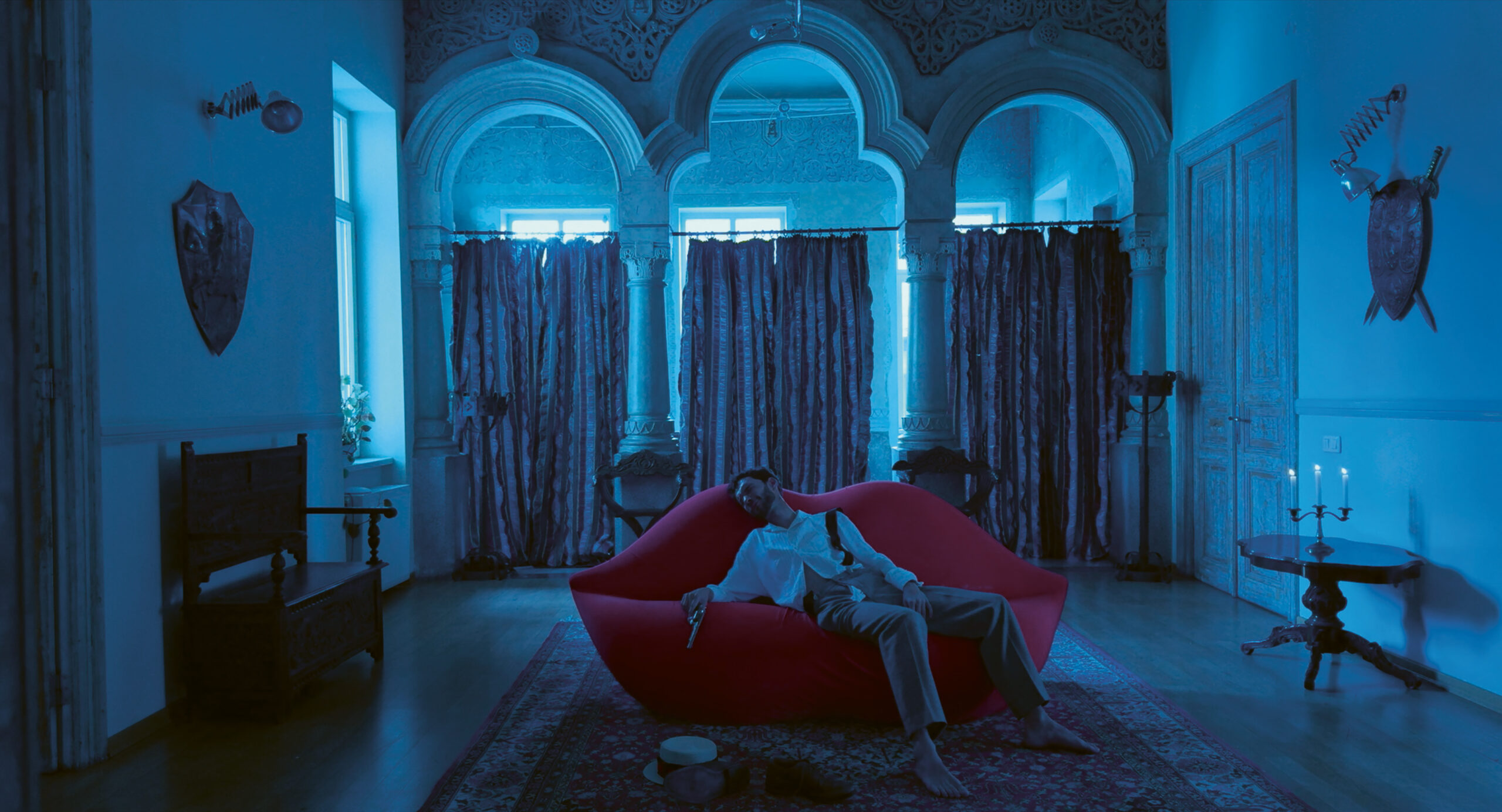
Dracula, 2025. Courtesy of Radu Jude
Julian: Ever since your debut feature The Happiest Girl in the World (2009), you have often returned to the film set as a location. What keeps you returning to it?
Radu: I guess it’s a lot of things, which I’m half-conscious of. One is that, of course, it’s a medium I know well. However, I’m more interested when I feel that there is something that goes beyond the frame of this domain in these stories. For instance, in Do Not Expect Too Much from the End of the World, the main character is a production assistant driving around Bucharest. But I felt that the film has something more to say – about the society of today, politics, the economy, and the way people engage with new technologies of images. I wouldn’t have made it if it were just about myself or about my own experience. I’m a bit opposed to what I now perceive as a kind of cancer in cinema, the kind of auto-fiction that a friend calls ‘ego docs’ where the filmmaker makes a film about their wife, their uncle, the divorce of their parents, or maybe a diary of their great-grandmother they discovered. Not all stories are necessarily exemplary. That’s why I always try to ask myself: is this a narrative or a subject that goes beyond the confines of the small story itself? If at least half of me says yes, I can go on to make it.
The self-referentiality of including scenes of a film shoot in a film might relate to modernism, where you can also find collage-like techniques, and maybe even other ancient forms of expression. If you take someone like Robert Musil or James Joyce, the author is very self-conscious about their writing of the book, as is the reader. This is the same if you read Don Quixote. I’m interested in this approach, using an ancient type of narrative structure for stories or subjects today. I wouldn’t call myself a cinephile anymore, but if I do have the time, I prefer to watch a lot of early cinema and avant-garde films from the 1930s, 50s and 60s. These forms are considered obsolete, but to me they don’t feel outdated at all, and in that sense, there’s no ‘new’ or ‘old’ films. Everything is a continuum. I feel I’m able to see the potentialities of an old form or idea more clearly than a new one when it is presented within the context of new technology.
Julian: In the way you’re speaking with me now, it’s clear your films are full of references and anecdotes from a variety of sources – literature, cinema, history, but also the internet. Can you give me a picture of a day in your life? How do you make your choices in what you engage with, and how do you keep track of them?
Radu: First of all, a regular day doesn’t exist for me. I crave having a routine, but it’s impossible. One of the great things about filmmaking is that it’s a very non-routine job. One day you’re filming somewhere, the next you’re editing the film somewhere else, and then you’re working on the sound in another place. When you’re writing, you can be at home, but when your film is done, you’re taking part in the film’s launch at a festival. I also teach. So routine is exactly what I lack in my life. In the time that remains when I’m not working on a project, I’m always collecting images or texts. If I see something interesting on the street, I’ll take a photo on my phone. But what I do after is what matters, and I have to be disciplined. When I’m back home, I put the photos in certain folders on my computer, because if I don’t do it right away I’ll forget about them. This is my only method, and it’s not even a method – just something done out of desperation. For each project, I have folders where I start by collecting things – an image, a phrase, something intuitive – and when a folder becomes big enough, I start researching things more properly. I also have a kind of general folder where I collect all kinds of quotations, anecdotes, stories and dialogues that I hear in the street or find in a book. When I’m preparing a project or a script, sometimes I can spend two or three days going through all this, because it’s a lot. People have said that I am not original because I only use quotations and ideas from others, but I think what is important is that you end up having something new when you put all these elements together. Cinema is an art that accommodates a lot of things. You can put a poem in cinema, but you cannot put a film in a poem. Cinema is like an ocean with all the rivers going into it – but when the rivers go into this ocean, they become the ocean.
Julian: It seems you spend a lot of time looking at images that other people would look away from or would not even notice. In Sleep #2, for example, you made an entire film based on the livestream of Andy Warhol’s grave in Pennsylvania. I had no idea this livestream existed – and I don’t even know why it does – yet you made a whole film about it.
Radu: Yes, I’m interested in this kind of thing. (Shows a screenshot of an online advert for a door knocker in the shape of testicles.) I found this on my computer today, where I’ve had it saved for about five years. It’s so idiotic, but in a way it expresses some-thing from our culture. Somebody else might just walk past it and chuckle, but I feel the urge to make something with it. I’ll probably use it as a prop or something.
Julian: I look forward to the moment it appears in a film of yours, and remember we had this conversation!
Radu: I’ll do my best! Something I do is say ‘Look at this!’ when other people don’t notice something. Maybe it goes back to paying attention to the smaller incidents in history we spoke about earlier.
…I don’t think I have a confrontational nature. I’m rather shy and peaceful. But I agree I have the impulse to point at something and share it with others…
Julian: Your work is often confron-tational – both in the sense that you confront the things that others might look away from, and that you confront your audience with these things as well. Which is the impulse that drives you – to confront things yourself, or to get others to confront such things?
Radu: Neither, actually. I don’t think I have a confrontational nature. I’m rather shy and peaceful. But I agree I have the impulse to point at something and share it with others. Sometimes I’m surprised by the powerful and occasionally violent reactions when I do this, as all I’m doing is saying, ‘Look at that, together with me.’ I don’t think along the lines of somebody like Gaspar Noé, for instance, who is a director who wants to purposefully create a violent reaction. People might call what I do radical, but all I’m doing is illustrating and describing phenomena that exist. I don’t wake up and think, ‘What can I do to be more radical today?’ The way I present such things is the only way I find to express them.
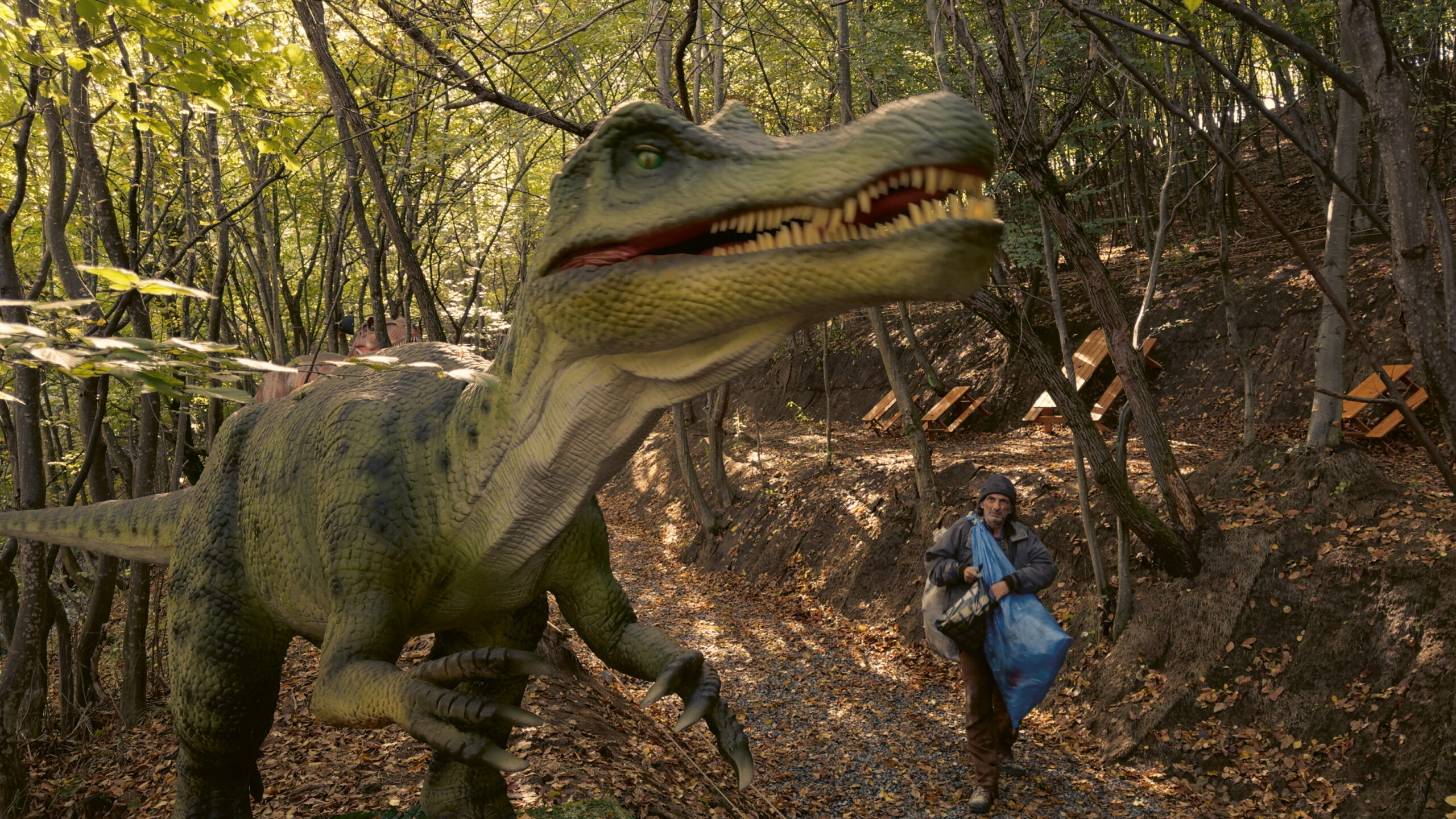
In a decrepit theme park on the outskirts of Cluj, a homeless man shuffles his way down unkempt, leaf-strewn paths, foraging for trash or treasure, and paying little mind to the creaky animatronic dinosaurs that tinnily roar as he passes. It’s an image that encapsulates the friction between comedy and tragedy, the banal and the bizarre, the real and the artificial, that powers Radu Jude’s extraordinary film Kontinental ’25 (2025). In it, the prolific Romanian writer-director dials back the heightened gonzo experimentation of his recent work to reflect the world as it is, which still permits ample room for the inexplicable. An obsolete, cut-rate Jurassic Park holds no wonder in this searing indictment of crumbling social care in a post-socialist economy: humanity can prey on itself just fine. Courtesy of Guy Lodge, Variety
Julian: Your sex scenes are often funny, even in a tender film like Scarred Hearts (2016), where we see the protagonist, the young Romanian poet Max Blecher, spend his endless days in a sanatorium where he is being treated for bone tuberculosis. Even with his whole upper body in a cast, his sex drive overtakes him and leads him into some painful but humorous situations.
Radu: First of all, I don’t think I could ever make a sex scene erotic or sensual. I see it in the same way as how I’ll never be able to make a real war movie with explosions and tanks. I just lack the sensibility and competence for that. I try to keep sex out of the stories I write, but if it ends up being part of the film, it’s only because it’s part of life. All sexual activity is very comical if you look at it from a certain perspective. I think it was Chekhov who said that, if you look carefully, every situation, person or thing has a comic side to it. People make jokes about Napoleon and Alexander the Great, even though they killed so many people. I’m interested in discovering this comic side to every story.
A certain amount of ridiculousness and humour depicted in their sex lives can make characters very, very human. The actress Glenda Jackson said something like, ‘If I need to think of something funny on the stage … I think about my sex life. And if I need to think about something sad, I also think about my sex life.’ Bad Luck Banging or Loony Porn opens with a sex scene – a private sex video that has leaked. Some people have called the scene vulgar and accused it of being pornographic. For me, the scene is just ridiculous. The dialogue is silly, the characters imitate porn, but it’s ‘dirty’ at such a low level that I’m shocked when people say it’s vulgar. I’d say it’s comedy.
…One thing that I think cinema can do is to invite you to look at a familiar space anew by framing things in such a way that you see them differently. You see some of the characteristics – or problems – more acutely…
Julian: In Bad Luck Banging or Loony Porn, after the scene you just described, we see the same character quietly walk around Bucharest. It’s something I noticed you do in a number of your films – after an abrasive scene or after multiple scenes with a lot of activity and dialogue, you turn to stillness. In these moments, the film opens up to the city and the characters’ surroundings. What is your relationship to the city as a filmmaker? Are you driving around like Angela in Do Not Expect Too Much from the End of the World, looking for locations, collecting them like you collect quotes and anecdotes?
Radu: I think cinema is an art of describing, and this includes the spaces. It’s one of the great things that cinema does: frame and show the relationship between different parts of a place. The Lumière brothers’ first films were also shot in cities, so, in that sense, urban landscapes have always been part of cinema. But cinema also moved to the countryside; actually, I’m working on a film set in the countryside of Romania that I hope to shoot next year. For the scene you mention in Bad Luck Banging or Loony Porn, I shot the character going into the city using 35mm film and a long lens with which I isolated parts of her while she walked around and parts of the architecture. One thing that I think cinema can do is to invite you to look at a familiar space anew by framing things in such a way that you see them differently. You see some of the characteristics – or problems – more acutely. I live in Bucharest, and unfortunately it’s a very difficult city to live in. It’s polluted, it lacks good public spaces, the buildings are badly made, and it’s getting more and more crowded. There are almost no trees, and the few that are left are getting cut down. The traffic in the city is hell, and the public transportation, despite some changes made in the last year, still isn’t practical. Sometimes I don’t go to the theatre even when it’s only three or four kilometres from where I live because it’d take me more than an hour to get there.
I find my places mostly by walking, not driving, because I don’t want to spend my life in traffic. Bucharest is a city traumatised by the complicated history that destroyed it – not only by several dictatorships but also by capitalism, which caused even more harm. All the strata of the city are visible simultaneously, and, as the scale of the city isn’t very big, you can put a camera in one position and show different points of history co-existing in the same shot. For instance, you can have a building from the communist period next to a villa from the 1930s, which also sits next to a block of flats that emerged in the new economy of recent years. At one glance, you can see right through Bucharest to the incompetence of those who run it, or the corruption, the greed and the lawlessness. It’s a city that doesn’t hide its nature.